
Everywhen
Queer. Southern.
Future. Past.
Outsider. Home?
Peter has devoted his life to making sculptures in response to visions of an angel. But after almost 40 years without a vision, he’s lost. Through reflections on his visions, growing up gay in Georgia in the 1960s, and his lost love Sam, Peter grapples with whether he’s wasted his life—and whether it’s worth carrying on living.
What Peter doesn’t realize is his “angel” is Ro, a real person in a dismal future who has visions of Peter, too. Ro figures out that Peter is from the past, so when a lack of food threatens Ro’s community, Ro is determined to influence Peter to help them in the future. But as Ro’s obsession with reaching Peter heightens, they risk losing their place in the community.
And the Ghost?
The Ghost ghosts.
Three Points of View
Peter
I ain’t saying my angel left me exactly, but they sure being awful damn quiet. Must be getting on thirty—no, almost forty years since I seen ‘em proper. Told me to build the thing, so I built the thing, and now what? Nuttin. Radio silence. I don’t wanna be telling the universe how to do its job, but that’s a mighty long dry spell for a prophet.
Ro
Ro knew many things. They knew how to start a fire with flint. They knew when to pick the zucchini before it got too watery. Ro knew they could sneak a tomato now and then from the garden, but their daddy would get mad if Ro took too many. Ro knew their daddy loved them, no matter how many tomatoes they snuck. Ro knew that music ran in their blood, just like it did in their daddy’s, like it probably did in their mama’s, though they never met her. Ro knew how to move their body with a beat, how to flit, fling, kick, squirm.
The Ghost
The Ghost ghosts about the ghost town where the people were before the leaving and dying the going and dying the fleeing and dying. The Ghost feeds on the good plants, the good bugs, the good squirms. The Ghost sucks honey flowers, pulls off white honey flowers and suck suck suckles the bottom, suckles the honey.
The Ghost is a lonely ghost.
The Ghost ain’t really a ghost.
But the Ghost feels like a ghost and that’s ghost enough, ain’t it? Ghosting around the after.

The story behind the story
In 2017, I visited Pasaquan, a stunning art environment on seven acres built by Eddie Owens Martin or St. EOM (pronounced “Ohm”). St. EOM had visions of gender-fluid beings from a utopic future called Pasaquan. This culminated in St. EOM transforming his mother’s house and yard into a representation of Pasaquan. He painted mandalas, built large cement sculptures, and covered walls with murals. The place was wildly different from anything I’d seen, and yet it was on an anonymous country road so similar to the ones I’d grown up with.
St. EOM and Pasaquan are fascinating in their own right, but I wondered about these future Pasaquoyans. What was their story? What if they were just as loving and flawed and human as the person having the vision?
The result is my novel Everywhen. Although the characters and events diverge significantly from the reality of St. EOM and Pasaquan, the kernel of the story began there. I am deeply indebted to the artwork of Eddie Owens Martin, to the men he hired to help build Pasaquan, and to the people and organizations who have documented St. EOM’s life and preserved Pasaquan, including but not limited to Fred and Cathy Fussell, Tom Patterson, Michael McFalls, Charles Fowler, the Marion County Historical Society, the Pasaquan Preservation Society, the Kohler Foundation, Columbus State University, and the CSU Archive.
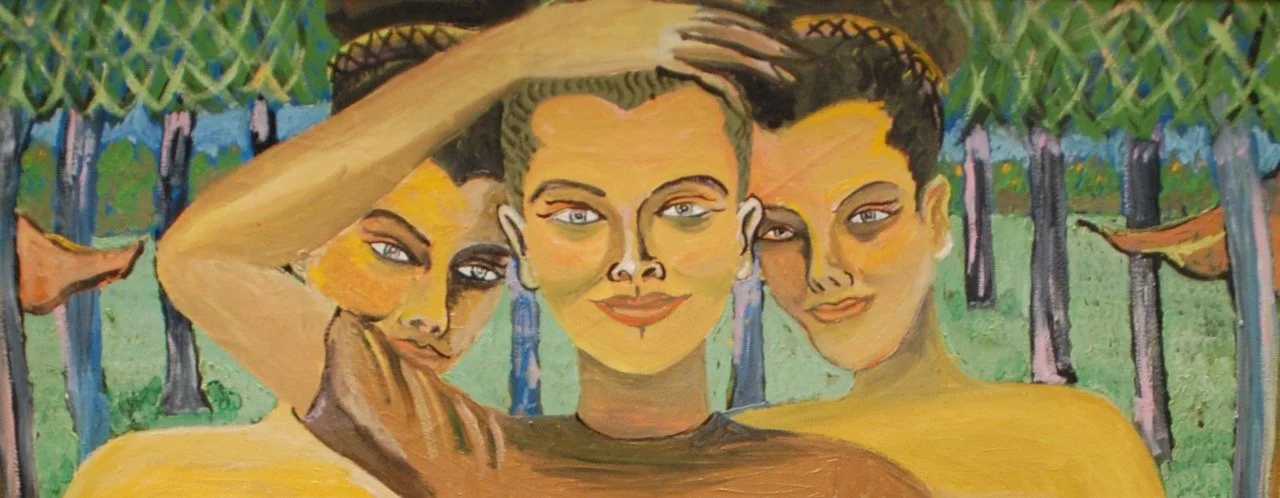
All photos on the Everywhen page are of artwork by Eddie Owens Martin or St. EOM.